Homeowners watching a structural drying crew set up equipment often ask the same question: why so many air movers, and why are they angled the way they are?
The Linear-Footage Calculation Behind Air Mover Count
Industry drying standards calculate air mover placement based on the linear footage of wet wall and the square footage of wet flooring in the drying chamber, not simply the size of the room. A large room with only a small section of wet baseboard needs far fewer units than a small room with water saturating every wall. If cost is on your mind, how our pricing works breaks down what typically drives the number up or down.
Why Angle Matters as Much as Count
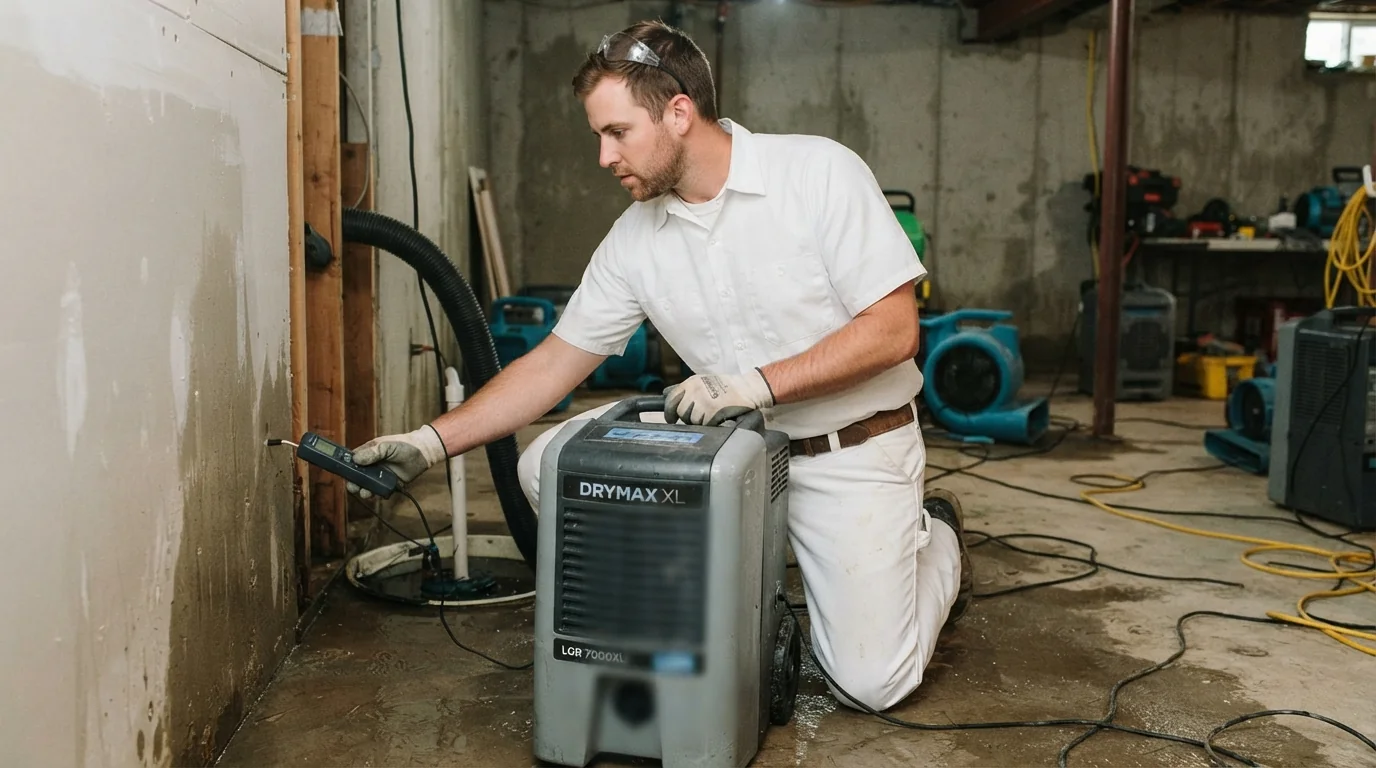
Air movers are typically angled at roughly a 15 to 45 degree angle to the wet surface, creating a sweeping airflow pattern across the material rather than blasting directly into it. This sweeping motion pulls moisture-laden air away from the surface continuously, which is what actually drives evaporation — a fan aimed straight at a wall does far less useful work than one angled to skim across it. We've answered a lot of related questions on answers to common questions.
Sequential Drying vs. Simultaneous Placement
In multi-room losses, some crews use a technique called sequential air movement, where a smaller number of high-velocity units are rotated between zones on a schedule rather than placing a large number of units simultaneously. Both approaches can be valid depending on the affected area — what matters is that the airflow calculation covers every wet surface over the course of the drying program. For background from an independent source, see the IICRC S500 restoration standard.
What Happens When Air Movers Are Under-Placed

Reducing the number of air movers below what the drying calculation calls for doesn't just slow the process evenly — it can leave specific under-serviced sections of a wall or floor with residual moisture even after the majority of the room reads dry. This is one of the most common causes of the follow-up mold calls covered in our guide to the 48-hour mold window. the EPA's moisture control guidance has useful guidance on this if you want to read further.
Balancing Air Movers With Dehumidification Capacity
Air movers evaporate moisture out of materials and into the air; dehumidifiers then have to remove that moisture from the air, or it simply resettles on cooler surfaces. Dehumidification capacity has to scale alongside air mover count, or the drying chamber's humidity climbs instead of falling. You can also review the Department of Energy's ventilation and humidity guidance for an outside perspective on this.